
The APA Method for learning English: Why does it work?
Meet the APA Method: The ultimate strategy to move beyond theory and learn English faster and efficiently.
Have you been studying English for years, you know countless grammar rules, possess a considerable vocabulary, but when it comes time to speak… you freeze? If your answer is yes, know that you are not alone. This is a common problem for thousands of people who have followed traditional teaching methods focused almost exclusively on theory.
The good news is that there is a solution: the APA Method for learning English.
This innovative approach is revolutionizing the way people achieve fluency because it understands a fundamental truth: a language is not just a set of rules to be memorized, but a living, dynamic tool for communication.
The method works because it takes you out of the role of a passive spectator and places you as the protagonist of your own learning.
Instead of just memorizing irregular verbs and prepositions, you learn to use English in real situations that make sense for your goals.
Do you want to understand your favorite movies and series without subtitles? Do you dream of landing that job at a multinational company? The APA cycle was designed to transform this theoretical knowledge into practical skill, building your confidence at every step.
It is based on a continuous cycle of three essential pillars that guarantee meaningful and lasting learning. Forget the frustration of studying without seeing results.
With this methodology, you will finally feel that you are truly progressing, transforming English into a natural part of your daily life.
Want to learn more about the APA Method for learning English? Let’s go!
What does the acronym APA mean in English teaching?
The genius of the APA Method lies in its simplicity and logic. The acronym represents the three fundamental and interconnected stages that make up the path to fluency: Acquire, Practice, and Adjust. Let’s understand what each one means in practice.
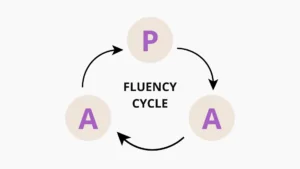
A – Acquire
The first stage, “Acquire,” goes far beyond sitting down with a grammar book. Here, the focus is on acquiring knowledge in a way that is contextualized and relevant to you. Instead of studying lists of isolated words, you learn vocabulary and structures within a context that interests you.
Think about your hobbies and goals. If you work in tech, you can learn by reading articles on innovation. If you love cinema, you can study the lines of your favorite characters. Active learning starts here, when you consume authentic content in English:
- Podcasts on personal development or international news.
- YouTube videos in your niche of interest.
- Series and movies with English subtitles.
- Articles and books related to your professional field.
In this phase, you are building your repertoire. English grammar is not ignored, but it is learned intuitively by observing how structures are used in real life. It is an immersion process that makes memorization techniques much more effective, as every new word or expression is connected to an idea or emotion.
P – Practice
This is the crucial bridge between theoretical knowledge and communication skill. The “Practice” stage is where you start to activate what you have learned. Practice needs to be constant and deliberate, transforming passive information into active knowledge.
Practice can take various forms, and the ideal approach is to combine different learning strategies:
- Shadowing: Listening to audio in English and trying to repeat it aloud, imitating the pronunciation and intonation.
- Writing: Keeping a diary, writing short summaries about what you watched or read.
- Interactive exercises: Using apps that offer fill-in-the-blank exercises, sentence building, and voice recognition.
- Conversation practice: This is the most important part. Talking about the topics you are learning, whether alone, recording your own voice, or with a study partner, tutor, or teacher.
It is during practice that you will make mistakes, and that is excellent! Every mistake is a learning opportunity. This is where you start to develop the “muscle memory” of speech, automating structures and sounds, and losing the fear of expressing yourself.
A – Adjust
The final stage of the cycle is the “Adjustment.” This is where the average student distinguishes themselves from the one who achieves excellence. Adjusting means identifying gaps in your knowledge and refining your skills. It is the moment for critical analysis and feedback.
While “Practice” is about doing, “Adjust” is about evaluating how it was done. If you only practice without adjusting, you run the risk of repeating mistakes until they become bad habits (fossilization).
Adjustment involves:
- Self-correction and Analysis: Listening to that recording you made in the practice stage and comparing it with the original. Was my intonation correct? Did I use the right preposition?
- Identifying Gaps: Realizing that, when trying to talk about a subject, you missed a specific word or got stuck on a grammatical structure. This “lack” is the gap that needs to be filled.
- Refining: Receiving feedback (from an AI or peers) and using that information to polish your pronunciation, choose more appropriate words, and sound more natural.
Adjustment is the engine that restarts the cycle. By identifying a gap (something you didn’t know how to say), you go back to the Acquire stage to seek this new information, creating a virtuous and infinite cycle of continuous improvement toward fluency.
A – Adjust (Real-World Application)
The final stage of the cycle is the “Adjustment.” This is where the magic happens and true fluency in English begins to consolidate. Adjusting means using the language to accomplish a real task in the world, without scripts or pre-defined exercises. It is the final test that proves your learning was effective.
The practical application of English is what solidifies knowledge and makes it permanent. Your brain stops translating and starts thinking in English. Examples of application include:
- Participating in a work meeting with foreign colleagues.
- Writing and replying to a complex professional email.
- Watching an entire movie without subtitles and managing to explain the story to someone.
- Traveling to another country and communicating with confidence in hotels, restaurants, and shops.
- Presenting a project or an idea to an international audience.
Every time you apply what you learned and practiced, the cycle closes and strengthens. A successful experience in application motivates you to learn more, creating a virtuous cycle of language skill development that leads you, safely and consistently, to fluency.
What is the difference between the APA Method and traditional courses?
The fundamental difference between the APA Cycle and traditional teaching methods lies in the philosophy behind each one. While conventional courses often treat English as a school subject, the APA Method sees it as a skill to be developed.
Focus on the Goal
- Traditional Methods: The main focus is grammatical accuracy. The goal is often to pass a test, complete the book, or learn a list of rules. This creates students who know a lot about English but don’t know how to use English.
- APA Method: The focus is effective communication. The goal is to use the language to perform real tasks. Grammar is a tool for communication, not the end goal.
Student’s Role
- Traditional Methods: The student is a passive receiver of information. They sit, listen to the teacher, take notes, and do repetitive exercises.
- APA Method: The student is the active protagonist of their learning. They seek content of their interest, define their practice goals, and place themselves in real application situations, taking responsibility for their progress.
Study Material
- Traditional Methods: Use textbooks with stiff dialogues and situations that rarely happen in real life, distancing the student from the practical use of the language.
- APA Method: Encourages the use of authentic and relevant materials. Movies, series, articles, music, and podcasts that the student genuinely likes, promoting an immersion in the language that is much more natural and enjoyable.
Approach to Mistakes
- Traditional Methods: Mistakes are frequently seen as failure, something to be avoided at all costs and sometimes punished with low grades. This generates fear and inhibition.
- APA Method: Mistakes are viewed as an essential and welcome part of the learning process. Every mistake is an opportunity for adjustment and improvement, a necessary step for the development of any skill.
How does the Acquire, Practice, and Adjust cycle work?
To understand the dynamics of the APA cycle, let’s imagine a practical scenario.
Suppose your goal is to learn how to use phrasal verbs related to work, such as “take on,” “carry out,” and “burn out.”
Step 1: Acquire (A)
You won’t start with a list of 50 phrasal verbs to memorize.
Instead, you will look for context. You might watch a YouTube video about “a day in the life of a project manager” or read a Harvard Business Review article about productivity. While consuming this content, you note down the phrasal verbs that appear and, most importantly, the context in which they are used.
- “She decided to take on a new challenging project.” (Assume a new responsibility)
- “The team needs to carry out the plan by Friday.” (Execute the plan)
- “He was close to burning out after working 12-hour days.” (Become exhausted from overwork)
You realize that “take on” has a connotation of challenge, “carry out” of task execution, and “burn out” of negative consequence. This is contextualized learning.
Step 2: Practice (P)
Now it is time to fix this knowledge.
- Active Exercises: You create your own sentences. “Next year, I want to take on more leadership roles.” “My main job is to carry out market analysis.” “I need a vacation to avoid burning out.”
- Shadowing: If you learned from a video, you go back to that part and repeat the exact phrase of the native speaker, mimicking the pronunciation and intonation.
Step 3: Adjust (A)
Here happens the magic that separates the amateur student from the advanced one. Instead of just moving on, you stop to analyze the quality of what you produced and identify gaps.
- Self-analysis (Recording): You record yourself speaking the sentences you created in the Practice stage and compare them with the original audio from the video. Upon listening, you realize that your pronunciation of “burn out” sounded very paused, losing the natural connection between the words (linking sounds). You identified a technical gap.
- External Feedback: You send your sentences to an AI (like Teacher Poli) and ask: “Make these sentences sound natural for a corporate environment?” The feedback reveals that, although “carry out” is grammatically correct, perhaps “execute” or “handle” would be more common in that specific context of your field.
- Course Correction: You discover that you were using “take on” for simple tasks, when the term is better used for larger responsibilities.
The Result of Adjustment: You identified that your grammar is good, but your pronunciation and contextual appropriateness need refinement. With this diagnosis, you don’t just “know” the word; you master it.
By identifying these gaps, the cycle restarts naturally. If the problem was pronunciation, you go back to Acquire (listening again) and Practice (repeating until you get it right), creating an upward spiral of continuous improvement.
s it possible to learn English faster with the APA Method?
Yes, it is absolutely possible to learn English faster and more efficiently with the APA Method.
However, it is crucial to understand what “faster” means in this context. It is not about an empty promise of fluency in three months, but rather a significant acceleration of your real and usable progress.
Speed comes from efficiency. Traditional methods waste an enormous amount of time and energy on low-impact activities. Studying vocabulary lists that you will never use or focusing on obscure grammar rules before knowing how to introduce yourself are examples of inefficiency.
The APA Method optimizes your study time by focusing directly on skills that generate communication.
Acceleration happens for three main reasons:
- Focus on the Essential: The cycle helps you prioritize what is most useful for communication. By focusing on learning and applying the most frequent vocabulary and structures, you gain communicative capacity much more quickly.
- Enhanced Retention: The combination of contextualized learning, practice with spaced repetition, and immediate application combats the forgetting curve brutally. You retain more of what you study, which means you don’t have to keep relearning the same things repeatedly. Less time is spent reviewing and more time is spent advancing.
- Building Motivation and Confidence: This is perhaps the greatest accelerator of all. In a traditional course, it can take months or even years for you to feel like you are making any real progress. With the APA Method, you see tangible results every week. Being able to have a small conversation, understand a snippet of a song, write an email without using a translator—these small victories generate a powerful cycle of motivation. Motivated students study more and with higher quality, which, in turn, accelerates learning even further.
Therefore, learning faster with the APA Method is not magic. It is the result of an intelligent teaching methodology that eliminates waste, maximizes retention, and keeps the student engaged and confident in their journey.
Why is English important for professional growth?
In today’s globalized and competitive job market, English has ceased to be a differentiator and has become a fundamental skill. Not mastering the language not only limits your opportunities but can mean career stagnation and significant financial losses.
Market data is clear and compelling: English is a catalyst for professional growth.
Salary surveys consistently show the impact of English on remuneration. According to a survey by Catho, one of the largest recruitment platforms in Brazil, a professional in a management position who is fluent in English can earn a salary up to 70% higher compared to a colleague in the same position who does not speak the language.
This difference extends across all hierarchical levels, from analysts to directors.
In essence, not speaking English could be costing you a promotion or, literally, thousands of reais every month.
But the impact goes far beyond the salary. Mastering English opens up a range of opportunities that remain inaccessible to the majority:
- Positions in Multinationals: The best and largest companies in the world operate in English. To occupy strategic positions in these companies, even when working in Brazil, fluency is a non-negotiable prerequisite.
- Remote Work Abroad: The rise of remote work has broken geographical barriers. Today, it is entirely possible to live in Brazil and work for a company in Europe or the United States, earning in dollars or euros. The only bridge to these vacancies is English.
- Networking and Global Collaboration: Participating in projects with international teams, attending global conferences and events, and building a solid network of contacts around the world depends on your ability to communicate in English.
- Access to Cutting-Edge Knowledge: The most important scientific articles, the most innovative courses, books that define trends, and the most up-to-date technology documentation are, in their vast majority, published first in English. Mastering the language means drinking knowledge straight from the source, putting you ahead of the competition.
This is where the APA Method for learning English becomes a strategic ally for professionals who have no time to lose.
Corporate life is busy, and spending years in a traditional English course that generates no practical results is a luxury no one can afford.
The APA Cycle accelerates your professional growth because it focuses on practical and applicable results. With this teaching methodology, you don’t need to wait two years to learn how to attend and participate in a meeting. You can focus your Acquire, Practice, and Adjust cycle specifically on the skills you need for your job:
- Need to improve your emails? You can Learn (Acquire) with examples of professional emails, Practice by writing drafts and using correction tools, and Adjust by sending a real email to an international colleague that same week.
- Have an important presentation? You can Learn (Acquire) the vocabulary of your field, Practice your speech with the shadowing technique and by recording yourself, and Adjust by doing a simulation of the presentation.
This pragmatic approach builds not only the skill but also the confidence to use English in the workplace.
The APA Method prepares you for the real situations you will face in your career, ensuring that your investment of time and effort translates directly into growth and better professional opportunities.